
Confirms Berg as one of Canada’s most significant critical minerals development projects, combining large-scale copper production with industry-leading molybdenum and silver output and a defined, stand-alone development pathway
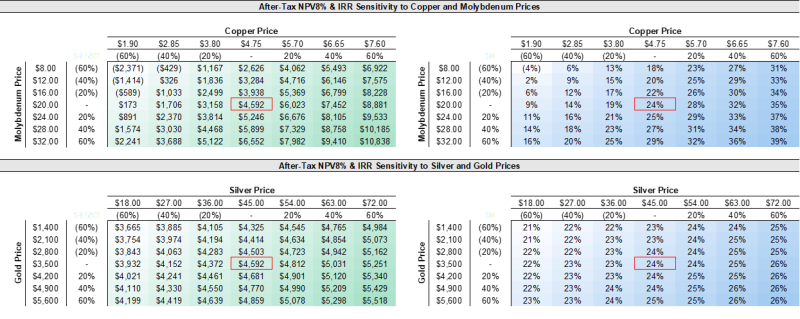
- Base case after-tax NPV8% of C$4.6 billion, IRR of 24%, and payback period of 2.9 years, based on long-term commodity price assumptions of US$4.75/lb copper, US$20.00/lb molybdenum, US$45/oz silver, and US$3,500/oz gold and an exchange rate of 0.73 US$/C$
- At spot prices as of June 2026 (US$6.45/lb copper, US$30.00/lb molybdenum, US$65/oz silver, and US$4,250/oz gold and an exchange rate of 0.73 US$/C$), a spot price sensitivity case generates an after-tax NPV8% of C$9.4 billion, an IRR of 36%, and a payback period of 1.8 years, underscoring the Project’s leverage to higher metal prices
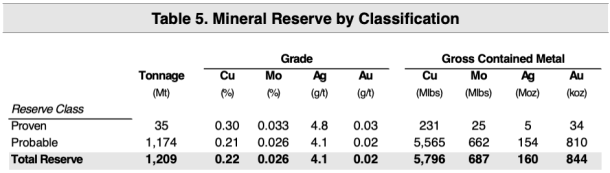
- Maiden Proven & Probable Mineral Reserve of 1.2 billion tonnes grading 0.22% copper, 0.026% molybdenum, 4.1 g/t silver, and 0.02 g/t gold, containing 5.8 billion pounds of copper, 687 million pounds of molybdenum, 160 million ounces of silver, and 0.8 million ounces of gold
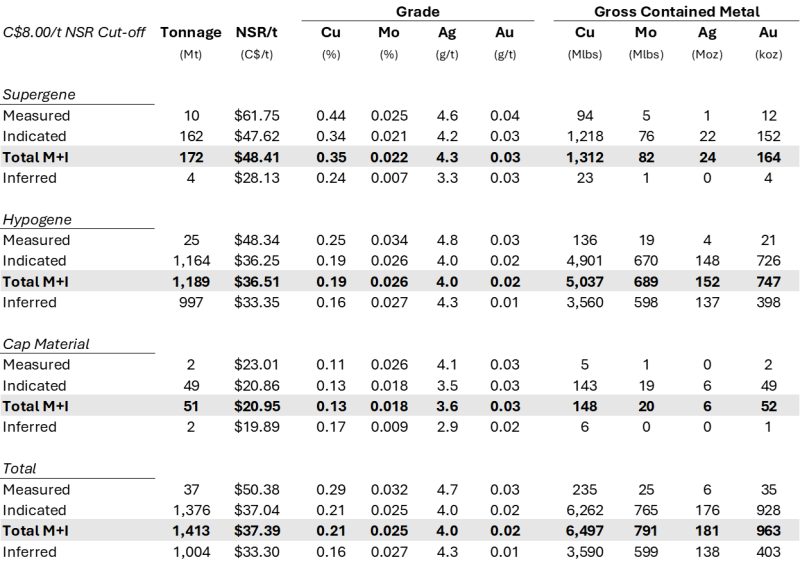
- Updated Mineral Resource Estimate includes Measured and Indicated Mineral Resources of 1.4 billion tonnes grading 0.21% copper, 0.025% molybdenum, 4.0 g/t silver, and 0.02 g/t gold, plus additional Inferred Mineral Resources of 1.0 billion tonnes grading 0.16% copper, 0.027% molybdenum, 4.3 g/t silver, and 0.01 g/t gold
- 28-year mine life with total production of 8.6 billion pounds (3.9 million tonnes) of copper equivalent (CuEq)1, including 4.9 billion pounds (2.2 million tonnes) of copper, 602 million pounds of molybdenum, and 89 million ounces of silver
- First 5 years of steady-state production averages 416 million pounds (189 thousand tonnes) of copper equivalent annually, including 270 million pounds (122 thousand tonnes) of copper, 21 million pounds of molybdenum, and 4 million ounces of silver
- Life of mine average annual production of 308 million pounds (140 thousand tonnes) of copper equivalent, including 176 million pounds (80 thousand tonnes) of copper, 21 million pounds of molybdenum, and 3 million ounces of silver
- Life of mine C1 co-product cash costs of US$1.95/lb payable CuEq and by-product cash costs of US$(0.17)/lb payable Cu
- Low life of mine strip ratio of 2.0:1, including waste pre-stripping requirements of 304 million tonnes
- Initial capital cost of C$4.7 billion and sustaining capital of C$1.7 billion, based on an EPCM execution approach and a three-year construction period, and including a total life of mine contingency of C$715 million, implying initial capital intensity of US$24,416/t CuEq annual average production capacity, and life of mine capital intensity of US$0.55/lb recovered CuEq
- Selected development case based on a 120,000 tonne per day concentrator and a new 230 kV transmission line connecting the Project to the BC Hydro grid, and downhill overland conveyor transport of ore to the process plant
- Simple, stand-alone development case based on a single-phase build, conventional open pit mining and processing, with no reliance on phased expansions or third-party major infrastructure
June 15, 2026 – Vancouver, British Columbia – Surge Copper Corp. (TSXV: SURG) (OTCQB: SRGXF) (Frankfurt: G6D2) (“Surge” or the “Company”) is pleased to announce the results of its Pre-Feasibility Study (the “PFS”), prepared in accordance with National Instrument 43-101 – Standards of Disclosure for Mineral Projects (“NI 43-101”), for the 100%-owned Berg Copper Project (“Berg” or the “Project”) located in central British Columbia. The Project is located within the Wet’suwet’en Yintah. The Company is actively engaging with the Wet’suwet’en Hereditary Chiefs and Houses and other potentially impacted communities in the region, including the Witset First Nation, Wet’suwet’en First Nation, Nee Tahi Buhn Indian Band, Skin Tyee First Nation, and Cheslatta Carrier Nation.
The PFS was completed by Ausenco Engineering Canada ULC (“Ausenco”) and Moose Mountain Technical Services Inc. (“MMTS”) and is based on an updated mineral resource estimate completed by MMTS. The PFS represents a significant milestone in the advancement of the Project and establishes a defined development pathway for one of British Columbia’s most significant emerging copper-molybdenum-silver projects.
All figures presented herein are on an unlevered, 100% basis, all currency figures are in Canadian dollars (“C$”) or United States dollars (“US$”) as specified, all tonnes are metric tonnes, and all ounces are Troy ounces.
Leif Nilsson, Chief Executive Officer, commented “Completion of the Berg PFS marks an important milestone for Surge and materially advances one of Canada’s most significant undeveloped copper projects. Berg now stands out not only for its scale, but also for the quality of its development profile, with long-life production of copper as a primary metal, and industry leading molybdenum and silver output, strong infrastructure advantages, and access to low-carbon hydroelectric power. Just as importantly, this study reflects a great deal of technical work completed since the PEA and provides a more defined foundation for the next stage of advancement, including continued work with First Nations, formal entry into the environmental assessment process, and future feasibility-level studies.”
The Office of the Wet’suwet’en stated “Chief Casbit and Thin House of the Gilseyhu Clan look forward to continuing to work with Surge Copper to implement a robust Wet’suwet’en assessment process for the proposed Berg Copper Project and to explore opportunities for the Wet’suwet’en and the region.”
Chief Whitford of the Cheslatta Carrier Nation reflected “We are encouraged by the results to date of Surge’s efforts at exploring this critical copper resource and their ongoing efforts at engagement and partnerships.”
British Columbia’s Premier, David Eby, stated “In a time of global uncertainty, it’s more important than ever that we build a strong, resilient economy here at home. We’re encouraged by projects like Surge’s Berg Copper Project to help British Columbia responsibly develop the critical minerals the world needs. This is how we create good jobs and the prosperity needed to improve services we all rely on. Our government will be there to support this work as it moves forward, grounded in partnership with First Nations and focused on long-term benefits for people across B.C.”
Minister of Mining and Critical Minerals, Jagrup Brar, commented “Supporting Surge Copper through the BC Critical Minerals Office (CMO) reflects our commitment to advancing critical minerals development in our province. Early co-ordination with CMO accelerates regulatory processes for B.C.’s future major mines by helping projects prepare for environmental assessment and permitting. Through projects like this, we can remain Canada’s largest copper producer, create new well-paying jobs, and continue to lead the way in responsible growth of the critical minerals sector, while maintaining world-class environmental and safety standards and supporting local communities.”
Webcast & Conference Call
The Company invites you to join a webcast and conference call on Monday June 15, 2026 at 4:30 p.m. Eastern Time, on which management will present the highlights of the PFS.
- Webcast link: https://event.choruscall.com/mediaframe/webcast.html?webcastid=DZovj8af
- Participant dial in (Canada / US toll free): 1-844-763-8274
- Participant dial in (International): +1-647-361-0247
Berg PFS Summary
The PFS outlines a large-scale, long-life conventional open pit mining operation feeding a concentrator process plant designed for a nominal throughput rate of 120,000 tonnes per day at average ore hardness. The selected development case reflects engineering trade-off work completed following the 2023 Preliminary Economic Assessment (the “PEA”) and establishes the basis for a conventional, stand-alone development of the Berg copper-molybdenum-silver deposit.
The Project is planned to be powered by hydroelectricity from the BC Hydro grid through a new 230 kV transmission line, expected to follow the same general corridor as the proposed mine access road. The access route utilizes existing forest service roads linking the Project to Houston, and the grid connection is planned through a new connection at the Telkwa substation just outside of Houston. The combination of strong regional infrastructure access and low-carbon grid power remains a key differentiating feature of the Project. The selected site layout also incorporates downhill overland conveyor transport of ore to the process plant, supporting efficient materials handling and reduced overall energy intensity.
The PFS is based on a significant body of technical work completed since the PEA, including metallurgical testwork, and geotechnical and hydrogeological drill programs within the proposed pit and infrastructure areas. The results of these programs informed key design criteria and contributed to the increased level of engineering definition reflected in the PFS.
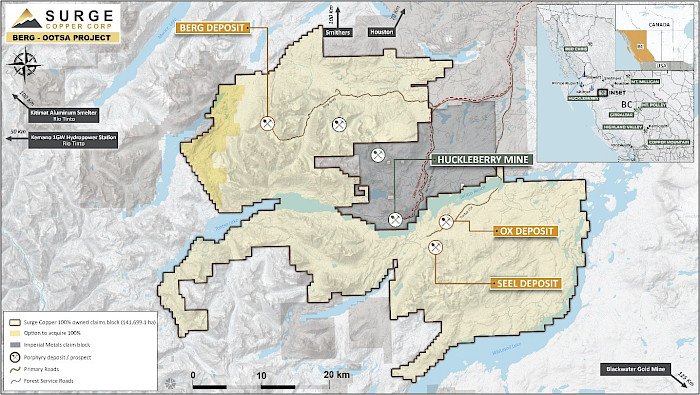
Figure 1. District Map
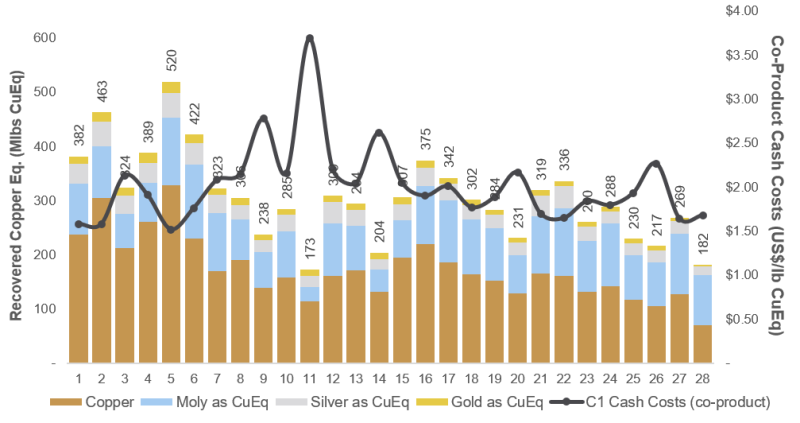
Figure 2. Production and Co-Product C1 Cash Cost Profile
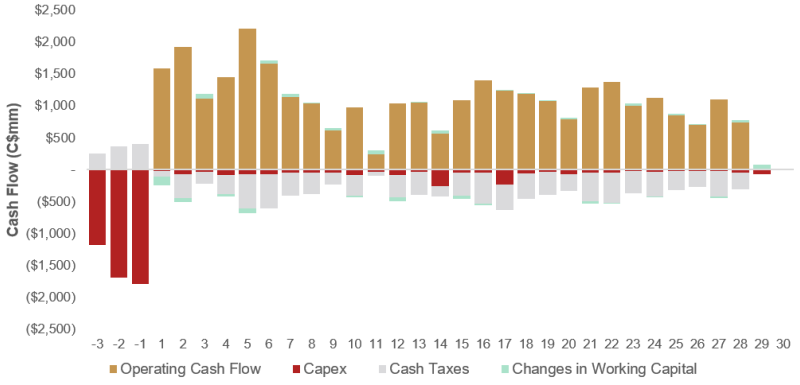
Figure 3. Cash Flow Components
|
Table 1. Key Financial and Economic Analysis Metrics |
|||
|
Base Case After-Tax Economic Metrics |
|
|
|
|
NPV8% |
C$mm |
$4,592 |
|
|
IRR |
% |
24% |
|
|
Payback Period |
years |
2.9 |
|
|
Pre-Production Capex |
C$mm |
$4,678 |
|
|
NPV / Capex |
x |
1.0x |
|
|
Capex / Total Production |
US$/lb Payable CuEq |
$0.55 |
|
|
Capex / Annual Production |
US$/t Recoverable CuEq |
$24,416 |
|
|
FCF Yield on Capex |
% |
16% |
|
|
|
|
|
|
|
Aggregate Undiscounted Financial Metrics |
Avg. Annual1 |
LOM Total |
|
|
Revenue |
C$mm |
$1,931 |
$53,700 |
|
On-site & Off-site Operating Costs |
C$mm |
$778 |
$21,565 |
|
Royalties |
C$mm |
$18 |
$503 |
|
Pre-Production Capex |
C$mm |
$1,559 |
$4,678 |
|
Sustaining Capex |
C$mm |
$62 |
$1,729 |
|
Cash Taxes |
C$mm |
$336 |
$8,302 |
|
Free Cash Flow |
C$mm |
$735 |
$16,867 |
|
|
|
|
|
|
Pricing Assumptions |
|
|
|
|
Copper |
US$/lb |
$4.75 |
|
|
Molybdenum |
US$/lb |
$20.00 |
|
|
Silver |
US$/oz |
$45.00 |
|
|
Gold |
US$/oz |
$3,500 |
|
|
Foreign Exchange |
USDCAD |
0.73 |
|
|
|
|
|
|
|
LOM Gross Revenue Contribution |
|
|
|
|
Copper |
% |
57% |
|
|
Molybdenum |
% |
30% |
|
|
Silver |
% |
9% |
|
|
Gold |
% |
4% |
|
|
1. Average annual financial metrics are weighted by total mill throughput in each year, except pre-production capex which is a simple average. |
|||
|
Table 2. Key Operating Metrics |
|||
|
Aggregate Operating Metrics |
|
Avg. Annual1 |
LOM Total |
|
Mine Life |
years |
- |
28 |
|
Milled Mineralized Material |
Mt |
44 |
1,209 |
|
Strip Ratio |
waste:ore |
- |
2.0 |
|
|
|
|
|
|
Grades |
|
|
|
|
Copper |
% Cu |
0.22% |
|
|
Molybdenum |
% Mo |
0.026% |
|
|
Silver |
g/t Ag |
4.1 |
|
|
Gold |
g/t Au |
0.02 |
|
|
|
|
|
|
|
Recoverable Production |
|
|
|
|
Copper |
Mlbs Cu |
176 |
4,875 |
|
Molybdenum |
Mlbs Mo |
21 |
602 |
|
Silver |
Moz Ag |
3 |
89 |
|
Gold |
koz Au |
16 |
439 |
|
Copper Equivalent |
Mlbs CuEq |
308 |
8,575 |
|
Copper Equivalent |
kt CuEq |
140 |
3,889 |
|
|
|
|
|
|
LOM Blended Process Recovery and Payability |
Recovery2 |
Payability |
|
|
Copper |
% |
84% |
96% |
|
Molybdenum |
% |
88% |
99% |
|
Silver |
% |
56% |
90% |
|
Gold |
% |
52% |
90% |
|
|
|
|
|
|
Cash Costs3 |
|
|
|
|
C1 Cash Costs (co-product) |
US$/lb Payable CuEq |
$1.95 |
|
|
C3 Cash Costs (co-product) |
US$/lb Payable CuEq |
$2.10 |
|
|
C1 Cash Costs (by-product) |
US$/lb Payable CuEq |
($0.17) |
|
|
C3 Cash Costs (by-product) |
US$/lb Payable CuEq |
$0.10 |
|
|
1. Average annual operating metrics are weighted by total mill throughput in each year. |
|||
|
Table 3. After-Tax NPV8% & IRR Sensitivity Tables |
|
|
|
|
Indigenous Nations & Project Advancement
The Project is located within the Wet’suwet’en Yintah. The Company is actively engaging with the Wet’suwet’en Hereditary Chiefs and Houses and other potentially impacted communities in the region, including the Witset First Nation, Wet’suwet’en First Nation, Nee Tahi Buhn Indian Band, Skin Tyee First Nation, and Cheslatta Carrier Nation. Surge believes that responsible advancement of the Project depends on working respectfully and collaboratively with First Nations whose rights and interests are connected to the Project area. The Company’s approach to engagement is grounded in transparency, relationship-building, and the pursuit of free, prior, and informed consent.
Over a number of years, Surge has built and maintained relationships with First Nations in the region through ongoing dialogue, information sharing, employment and training opportunities, and engagement with leadership on Project-related activities. As the Project has advanced, this work has increasingly focused on deepening relationships, better understanding Nation-specific priorities and areas of concern, and ensuring that appropriate capacity and resourcing are in place to support meaningful participation in Project planning. This has included early discussions regarding an Indigenous-led assessment process grounded in the hereditary governance of the Wet’suwet’en people, which is intended to proceed in parallel with and help inform the broader environmental assessment process.
Completion of the PFS marks an important stage in the Project’s advancement and provides a stronger technical foundation for continued engagement as the Company moves toward environmental assessment and regulatory processes. Surge welcomes the opportunity to continue working with First Nations as further engineering, environmental studies, and Project planning activities proceed, including through discussions relating to potential Project effects, mitigation and design considerations, and the consideration of Indigenous knowledge, cultural well-being, and community priorities in Project planning and decision-making.
Surge views this work as fundamental to the long-term advancement of the Project and looks forward to continuing to build relationships with First Nations in a manner that is thoughtful, transparent, and focused on achieving durable outcomes over time.
Updated Mineral Resource Estimate & Maiden Mineral Reserves
In conjunction with the PFS, an updated Mineral Resource Estimate (“MRE”) has been completed for the Berg deposit, together with a maiden Mineral Reserve estimate supported by the PFS mine plan. Block model estimation was completed by Sue Bird, P.Eng., of MMTS, an independent Qualified Person as defined by NI 43-101. The updated MRE has an effective date of June 12, 2026. The mine plan and Mineral Reserve estimate was completed by Marc Schulte, P.Eng., of MMTS, an independent Qualified Person as defined by NI 43-101. The Mineral Reserve estimate has an effective date of June 12, 2026.
The updated MRE benefits from additional drilling completed since the PEA, expanded gold and silver assay coverage from historical core, updated geological and geostatistical modelling, and revised metallurgical recovery assumptions based on the expanded metallurgical testwork database completed in support of the PFS.
Data from 249 core holes totalling 66,229 metres of drilling and 59,215 metres of assaying has been used in the updated MRE. Mineralized domains were defined for the principal weathering and lithological units of the deposit. The grades for copper, molybdenum, silver, and gold were estimated using capped and composited assay data within a three-dimensional block model. Classification of Mineral Resources was based on drill spacing, geological continuity, and estimation confidence. The MRE is constrained by an open pit shell demonstrating reasonable prospects for eventual economic extraction using a net smelter return cut-off grade of C$8.00/t.
Mineral Resources that are not Mineral Reserves do not have demonstrated economic viability. There are no other known factors or issues that materially affect the MRE other than normal risks faced by mining projects in the province of British Columbia, Canada, in terms of environmental, permitting, taxation, socio-economic, marketing, and political factors.
The Mineral Reserve estimate is a subset of the updated MRE and supported by the PFS engineering and economic analysis. Proven and Probable Mineral Reserves are derived from the Measured and Indicated Mineral Resources and are prepared in accordance with the Canadian Institute of Mining, Metallurgy and Petroleum (CIM) Definition Standards on Mineral Resources and Reserves (2014). Inferred Mineral Resources are set to waste. The Mineral Reserve estimate utilizes a C$9.25/t NSR cutoff grade and assumes a 15 metre selective mining unit (“SMU”) block size. The SMU includes an estimated 5-8% dilution from mineralization and the Mineral Reserve estimate includes an additional applied 4% mining loss.
|
Table 4. Mineral Resource Estimate by Classification and Mineralization Domain at Base Case NSR Cut-off of C$8.00/t |
|
Notes:
|
|
|
|
Notes to the Mineral Reserve:
|
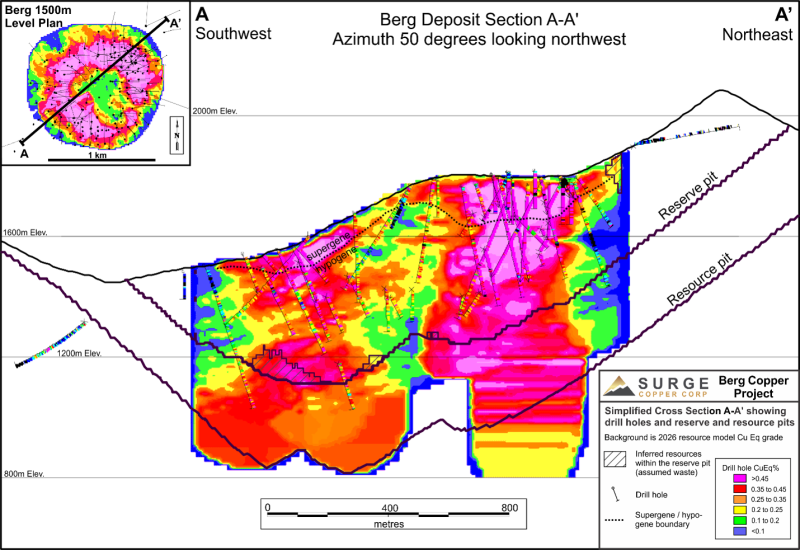
Figure 4. Mineral Resource Cross Section Showing Resource Pit and Reserve Pit
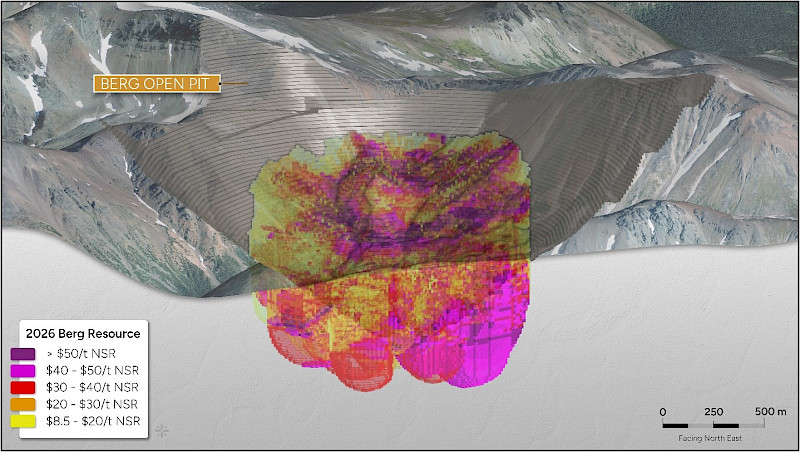
Figure 5. 3D View of Block Model with Reserve Pit
Infrastructure & Site Layout
The Project is currently accessible by road via an existing network of forest service roads extending approximately 116 kilometres from Houston, British Columbia. The PFS contemplates continued use and upgrading of this corridor, together with construction of approximately 17 kilometres of additional site access road, to provide continuous access to the process plant, mine site, and associated site infrastructure. The selected site layout reflects the Project’s favourable regional infrastructure setting and supports efficient integration of the principal mine, process, and materials handling facilities.
The PFS is based on a new 230 kV transmission line connecting the Project to the BC Hydro grid. The selected base case contemplates a transmission line route that generally follows the mine access road and existing forest service roads to Houston, with grid connection through a new connection at the Telkwa substation just outside of Houston. This configuration was selected as the base case for the PFS as a straightforward stand-alone power solution that does not rely on third-party privately owned infrastructure, while preserving flexibility to continue evaluating other potential power supply alternatives as the Project advances.
The selected site layout positions the process plant approximately 400 metres below the open pit and primary crusher, allowing mineralized material to be transported to the plant site by downhill overland conveyor. This configuration remains an important feature of the Project, supporting efficient materials handling and reduced overall energy intensity. The access road, conveyor corridor, and transmission infrastructure have been designed in an integrated manner to support constructability, renewable energy use, and overall site efficiency.
Tailings and waste rock from the Project are planned to be managed within a combined tailings and waste management facility located in proximity to the process plant. The facility has been designed as a co-disposal site for slurry tailings from the process plant and potentially acid-generating waste rock from the open pit, taking advantage of favourable local topography to support embankment design and overall footprint efficiency. In addition to having sufficient capacity for the mine plan contemplated in the PFS, the selected facility area also provides meaningful future expansion potential, which the Company considers to be an important strategic attribute of the Project.
The selected infrastructure layout reflects the increased level of engineering definition completed for the PFS and was informed by geotechnical, hydrogeological, and site investigations completed since the PEA.
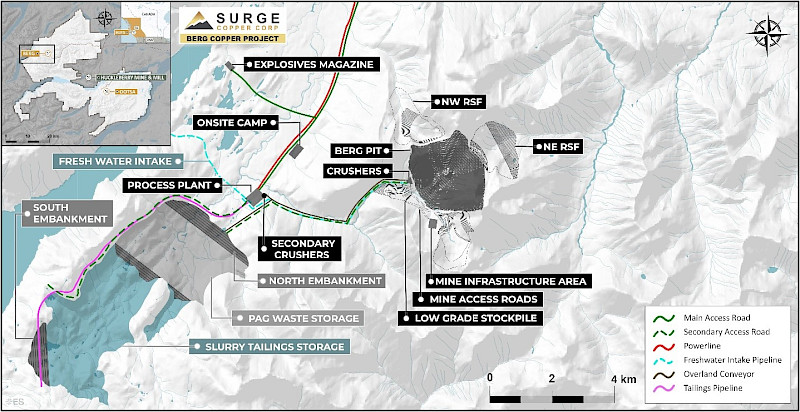
Figure 6. Schematic Layout of Key Components of Site Infrastructure
Open Pit Mine Plan
Open pit mine design, production scheduling, and cost estimation for the PFS have been completed by MMTS and are based on a large-scale conventional drill-blast-load-haul open pit mining operation in mountainous terrain. Open pit operations are anticipated to run for 31 years, including 3 full years of pre-production mining.
The mine plan is based on Proven and Probable Mineral Reserves of 1,209 million tonnes grading 0.22% Cu, 0.026% Mo, 4.1 g/t Ag, and 0.02 g/t Au, at a life of mine strip ratio of 2.0:1, inclusive of 304 Mt of capitalized waste pre-stripping and 39 Mt of capitalized ore pre-stripping. The Company also notes that approximately 202 Mt of Inferred Mineral Resources grading 0.15% Cu, 0.014% Mo, 3.3 g/t Ag, and 0.02 g/t Au remain within the reserve pit design and are treated as waste in the current mine plan. Subject to future conversion drilling and further study, these tonnes may present opportunities for future project optimization.
The open pit has been designed and sequenced into six phases, or pushbacks, to prioritize higher-value portions of the deposit earlier in the mine life, while maintaining practical pit access and operational flexibility. The production schedule supports average mill feed of approximately 43.2 million tonnes per annum over a mine life of 28 years. Peak annual mill feed is estimated at 48.0 million tonnes while processing softer supergene ore, while peak total material movement, including waste, is estimated at 200.0 million tonnes per year. Lower-grade material is stockpiled adjacent to the pit, during certain production periods, for processing later in the mine life.
Open pit mining is planned on 15 metre benches using an owner-operated fleet, consisting of electric and diesel rotary drills, electric cable shovels, diesel hydraulic shovels, and diesel-powered ultra-class haul trucks. While the base case mine plan assumes conventional haul truck technology, the Project may benefit from future adoption of electrified in-pit material transport, as such technologies continue to mature. Ore is to be hauled to a run-of-mine crusher located adjacent to the pit and then transported approximately 5.6 kilometres by downhill overland conveyor to the process plant site. The conveyor system also includes an additional 1.7 kilometre leg for transport of potentially acid-generating waste rock to the tailings and waste management facility. Non-PAG waste rock is planned to be stored in facilities adjacent to the pit, with certain material also used in construction of engineered embankments and related site infrastructure.
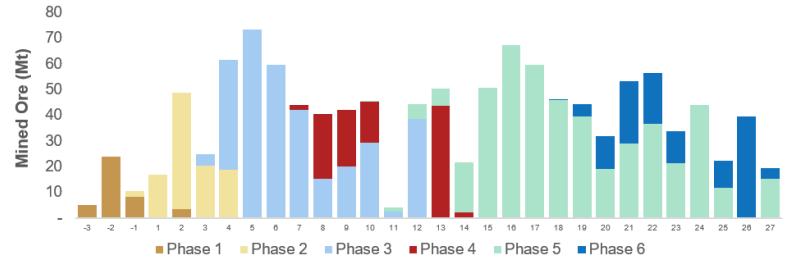
Figure 7. Mine Plan by Phase
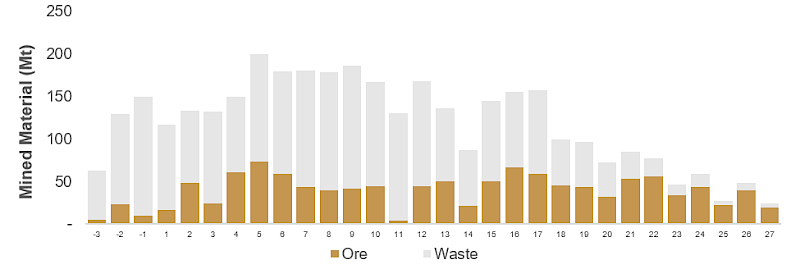
Figure 8. Mine Plan by Material Type
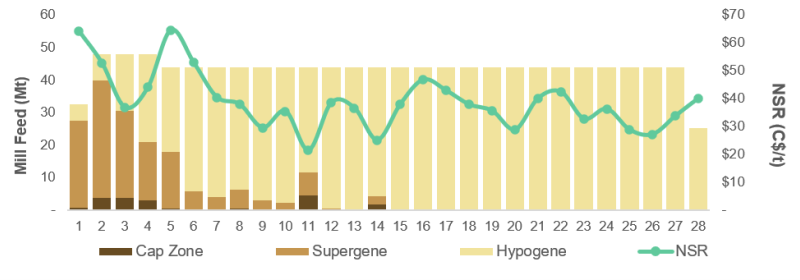
Figure 9. Process Plant Feed by Ore Type
Metallurgical Testing and Mineral Processing Flowsheet
Significant metallurgical testwork has been completed on material from the Berg deposit through multiple programs, including historical testwork completed between 2008 and 2010 and a comprehensive follow-up program carried out by ALS Metallurgy Kamloops (“ALS”) from June 2024 to May 2025 in support of the PFS. The recent program was designed to expand on prior work by improving recovery profiles, validating flotation performance across major lithologies and weathering domains, and confirming the efficiency of copper-molybdenum separation for production of separate marketable concentrates.
The ALS program utilized more than 1,350 kilograms of representative sample material to produce three master composites reflecting the hypogene, transitional supergene, and supergene zones of the deposit. In addition, 27 variability composites were tested to assess recovery performance and comminution characteristics across a broad range of mineralogical and spatial conditions throughout the proposed open pit. The testwork confirmed the suitability of a conventional flotation circuit comprising primary grinding, rougher and cleaner flotation stages, and copper-molybdenum separation, with minimal regrind requirements and no dependence on speciality reagents.
Locked cycle testing returned recoveries of up to 90.7% copper and 93.0% molybdenum to a bulk concentrate grading 29.7% copper. Copper-molybdenum separation testing also returned excellent results, including molybdenum recoveries of up to 94.6% and 95.6% for the hypogene and supergene composites, respectively, to high-grade molybdenum concentrates. Final representative copper and molybdenum concentrate products were confirmed to be clean and within commercial specifications. Based on grade-recovery regression formulas derived from the metallurgical testwork database and applied in the PFS, estimated life of mine average recoveries across all mineralization domains are 84% for copper, 88% for molybdenum, 55% for silver, and 52% for gold. In addition, independent concentrate marketing consultants retained by the Company have reviewed the expected concentrate specifications and provided input on assumed payability and commercial terms for both copper and molybdenum concentrates used in the PFS. On this basis, the PFS incorporates updated metallurgical assumptions reflecting the expanded testwork database and the increased confidence in process performance achieved since completion of the PEA.
Capital and Operating Cost Estimates
The PFS includes a capital cost estimate prepared by Ausenco and MMTS based on an EPCM execution approach that aligns with AACE Class 4 standards to a level of ±30% confidence in cost estimate. The estimate reflects the selected development case and incorporates use of existing regional road infrastructure. An average contingency of 19% has been applied to direct and indirect capital costs in a manner consistent with the level of project definition achieved at the PFS stage, with selected items carrying lower contingency where supported by recent vendor quotations or other high-confidence cost inputs. The CAPEX estimate includes 83% of process plant mechanical input costs supported by vendor quotations. Initial capital is estimated at C$4.7 billion, including a contingency of C$574 million, and is assumed to be incurred over a three-year construction period. Mining equipment capital has been estimated on an owner-purchased basis and is included within initial capital and sustaining capital over the life of mine, as applicable. Sustaining capital over the life of mine is estimated at C$1.7 billion, including a contingency of C$141 million, and consists primarily of mining fleet replacement, and tailings and waste management facility construction. Closure cost is estimated at approximately C$236 million.
Initial capital estimates include:
|
Table 6. Initial Capital (C$mm) |
|
|
Mine |
|
|
Waste & Ore Pre-stripping |
$806 |
|
Mining Fleet |
$679 |
|
Site Development & Mine Infrastructure |
$204 |
|
Subtotal |
$1,690 |
|
Processing & Infrastructure |
|
|
Crushing & Materials Handling |
$261 |
|
Process Plant |
$817 |
|
Tailings & Water Management |
$449 |
|
Power, Roads & Site Infrastructure |
$353 |
|
Subtotal |
$1,881 |
|
Total Directs |
$3,571 |
|
Indirects |
$432 |
|
Owner's Costs |
$101 |
|
Contingency |
$574 |
|
Total |
$4,678 |
|
N.B.: numbers may not sum due to rounding |
|
Operating costs have been estimated on a first-principles basis using current benchmark data, vendor inputs, and quoted unit rates where available. The PFS assumes an owner-operated project, with labour and operating assumptions reflecting the planned scale and location of the operation. Surge is working with local communities and the provincial government to best understand potential workforce planning, upskilling and training potential with aims of having at minimum 50% of the workforce sourced from the local and regional area, and that hourly personnel would operate on a rotating shift basis.
The total operating costs are broken down as follows:
|
Table 7. Operating Costs |
||
|
On-site Unit Operating Costs |
||
|
Mining |
C$/t mined |
$2.51 |
|
Mining |
C$/t milled |
$6.86 |
|
Processing |
C$/t milled |
$7.24 |
|
G&A Expenses |
C$/t milled |
$0.90 |
|
Total |
C$/t milled |
$15.00 |
|
Off-site Unit Operating Costs |
||
|
Transport |
C$/t milled |
$1.58 |
|
Cu Treatment |
C$/t milled |
$0.39 |
|
Refining |
C$/t milled |
$0.87 |
|
Total |
C$/t milled |
$2.84 |
|
Total Opex |
C$/t milled |
$17.84 |
|
N.B.: numbers may not sum due to rounding |
||
Closure & Reclamation
Closure and reclamation planning for the Project has been developed with the objective of supporting long-term physical and geochemical stability of the site following completion of mining operations. Prior to construction, the Company would be required to complete the applicable regulatory filings relating to closure and reclamation, including the provision of any required bonding or financial security, as part of the Project’s closure planning framework. During operations, water from the tailings and waste management facility is planned to be recycled back to the process plant for use in flotation to reduce overall water demand and minimize discharge requirements.
At the end of mine life, closure activities are expected to include removal of all major process facilities and remediation of disturbed areas to return the site, where practicable, to a stable natural condition. The Company intends to work with First Nations to help guide reclamation planning in a manner that reflects Indigenous perspectives, including through discussions on future land use and the preferred long-term vision for the site following closure.
The open pit and waste rock storage areas would be re-contoured as required for long-term stability and engineered to provide appropriate runoff control, with revegetation undertaken where appropriate, including in areas below tree line.
Tailings management during closure is expected to include drainage of supernatant water, treatment of water to remove residual process-related constituents prior to release to the environment and capping of the remaining tailings surface. The closure concept contemplates that, following drainage, the upper surface of the tailings facility would consist largely of sand and native waste rock materials from the open pit, which would then be capped and revegetated to promote long-term stability and support future wildlife use.
The remaining open pit area is expected to fill with water over time following closure. Water quality monitoring, testing, and treatment, where required, would continue after closure until long-term site stability has been demonstrated. Surge’s closure planning for the Project is intended to support a progressive and responsible transition of the site at the end of mine life, consistent with regulatory requirements and long-term environmental stewardship objectives.
Taxation & Royalties
The PFS models provincial mining taxes in accordance with the British Columbia Mineral Tax Act, as well as applicable provincial and federal income taxes. Provincial mining taxes include a 2% tax on net current proceeds, being a prescribed gross profit measure, and a 13% tax on net revenue, being a prescribed profit measure that allows for the recovery of capital expenditures and certain other deductions and credits including the 2% tax paid. Provincial and federal income taxes are modelled at a combined rate of 27% on taxable income, after deductions for provincial mining taxes paid and accelerated depreciation on eligible capital expenditures.
The PFS also incorporates the effect of the Clean Technology Manufacturing Investment Tax Credit, a 30% refundable investment tax credit applicable to eligible machinery and equipment, including certain industrial vehicles, acquired to extract and process critical minerals. On this basis, the PFS estimates total undiscounted net taxes paid over the life of mine of C$8.3 billion, including C$5.9 billion to the Province of British Columbia and C$2.5 billion to the Government of Canada, implying an estimated life of mine tax rate on taxable income of approximately 36%.
In addition, the PFS models a 1% net smelter return royalty payable to Royal Gold Inc., totalling C$503 million over the life-of-mine.
Environmental Assessment & Permitting
Completion of the PFS is expected to mark an important milestone in the advancement of the Project and support the Company’s planned filing of an Initial Project Description to commence the British Columbia environmental assessment and federal impact assessment processes. The Company expects the Project will require both provincial and federal assessments, and intends to seek a substitution process led by the Province on behalf of both jurisdictions. In parallel, the Company is also planning for an Indigenous-led assessment to be carried out by the Office of the Wet’suwet’en (the “OW”), the engagement and coordination office mandated by the Wet’suwet’en Houses and Hereditary Chiefs (the “Wet’suwet’en Assessment”). Following completion of the PFS, Surge intends to advance the Project into environmental assessment with a continued focus on aligning Project design and environmental and cultural studies with the provincial, federal, and Wet’suwet’en Assessment processes.
Over the past three years, Surge has invested significantly in environmental baseline programs across the key areas of the Project footprint to support future assessment and permitting activities. This work has advanced environmental understanding of the Project area across the principal disciplines relevant to effects assessment, mitigation planning, and future regulatory filings. Together with the higher level of engineering definition reflected in the PFS, these baseline programs form an important part of the technical foundation for the next stage of Project advancement.
The Company intends to continue working closely with the Wet’suwet’en Hereditary Chiefs and Houses and other potentially impacted communities as these processes advance, with the goal of supporting transparent and informed decision-making and helping to ensure that Nation-specific priorities, interests, rights and perspectives are identified and considered early in Project planning.
The Project also incorporates several design features intended to support responsible development and reduce overall carbon intensity, including planned connection to BC’s low-carbon hydroelectric grid and the use of electrically powered overland conveyor systems for materials handling. Surge believes these attributes strengthen Berg’s positioning as a large-scale, long-life critical minerals project in British Columbia.
The Company also notes that the Project has been accepted into British Columbia’s Critical Minerals Office, which is intended to support coordination and early preparedness for priority critical minerals projects as they advance through the regulatory processes.
Future Opportunities
The PFS outlines a selected development case for the Project based on currently available technical, economic, and engineering information. While the Company believes the PFS reflects a well-defined and technically robust development plan, the Project continues to retain longer-term opportunities that are not required to support the PFS case.
These include potential future exploration upside within and adjacent to the Berg deposit, as well as broader district-scale opportunities across the Company’s mineral tenure position that are not reflected in the updated MRE, maiden Mineral Reserve estimate, or PFS mine plan. In addition, certain Inferred Mineral Resources remain within or below the ultimate reserve pit shell but are excluded from the current Mineral Reserve estimate and mine plan. Subject to future conversion drilling and further technical study, these tonnes may present opportunities for incremental mine plan optimization in future development stages. Certain elements of the selected infrastructure configuration, including the capacity and expansion potential of the tailings and waste management facility area, may also provide additional flexibility as the Project advances.
Next Steps
The Company will file an NI 43-101 technical report in respect of the PFS and MRE on SEDAR+ within 45 days of this news release. The technical report will contain important details and supporting information not included in this press release. With the PFS now complete, Surge is positioned to move Berg into its next phase of advancement. The Company is fully funded for its planned 2026 activities and intends to maintain momentum through a coordinated program of Indigenous engagement, environmental assessment entry, field work, and technical studies aimed at supporting future feasibility-level advancement.
Key next steps are expected to include:
- Continuing to work closely with First Nations as Project planning advances, including through ongoing engagement, information sharing, and collaborative work aimed at supporting Indigenous-led assessment and review processes, addressing Nation-specific priorities and potential Project effects, and informing future Project design and mitigation planning.
- Filing an Initial Project Description and formally advancing the Project into the British Columbia environmental assessment process, while continuing to coordinate environmental studies, engineering, Indigenous engagement, and regulatory planning.
- Undertaking a 2026 field program including geotechnical, geochemical, hydrogeological, and resource drilling, together with continued environmental baseline programs across key areas of the Project footprint, to support future study work and ongoing advancement of the Project.
- Completing additional technical work, including metallurgical testwork and other engineering and study activities, to support future feasibility-level studies and continued refinement of the Project’s development pathway.
Qualified Persons
A team of Independent Qualified Persons (as such term is defined under NI 43-101) at Ausenco and MMTS has led the PFS and has reviewed and verified the technical disclosure in this press release, including:
Peter Mehrfert, P.Eng., of Ausenco is an independent QP for the process and infrastructure capital and operating cost estimation, project financials, metallurgical test work and recovery model.
Jonathan Cooper, P.Eng., of Ausenco is an independent QP for the water management infrastructure and planning.
Scott Elfen, P.Eng., of Ausenco is an independent QP for the tailings and waste rock management facility.
James Millard, P.Eng., of Ausenco is an independent QP for the environmental and permitting studies.
Sue Bird, P.Eng., of MMTS is an independent QP for the Mineral Resource Estimate.
Marc Schulte, P.Eng., of MMTS is an independent QP for the Mineral Reserve Estimate, mine planning and cost estimation.
Dr. Shane Ebert P.Geo., is the Qualified Person for the Berg Copper Project as defined by National Instrument 43-101 and has approved the technical disclosure contained in this news release. Dr. Ebert is an Officer and a Director of Surge and is not independent of the Company.
Mark Wheeler, P.Eng., VP of Projects at the Company as well as a Qualified Person as defined by National Instrument 43-101, has supervised the preparation of the technical information in this news release.
About Ausenco
Ausenco is a global engineering, consulting and project delivery firm built for the minerals and metals industry. With three decades of global experience, Ausenco works alongside clients to navigate complex challenges from first study to final closure—across every phase, on five continents. Deeply rooted in the minerals and metals industry, their people combine technical depth, hands-on expertise, and hard-earned insight to deliver practical, forward-thinking solutions that reduce risk and unlock value. (www.ausenco.com).
About Moose Mountain Technical Services
Moose Mountain Technical Services (MMTS) is an association of Geologists, Engineers, and Technicians providing extensive experience in geology, mine engineering services, and EPCM support to the mining industry. From early grassroots exploration to resource modeling, advanced engineering studies and due diligence studies, environmental and sustainability evaluations. MMTS has worked on several early-stage mining projects that have been developed into operating mines. On some of these projects, MMTS has been involved at every stage, from the very first resource models and concept studies all the way through to ongoing operations and closure support.
About Surge Copper Corp.
Surge Copper Corp. is a Canadian resource company advancing one of British Columbia’s emerging copper districts. The Company’s 100%-owned Berg Copper Project hosts a large-scale copper-molybdenum-silver deposit in central British Columbia supported by a Pre-Feasibility Study and Mineral Reserve estimate that establish a defined development pathway for a long-life copper project with significant molybdenum, silver, and gold by-product production.
In addition to Berg, Surge controls a large, contiguous mineral claim package that includes multiple advanced porphyry deposits, including the Ootsa Property adjacent to the past-producing Huckleberry Mine. Collectively, the Company’s assets position Surge as a potential long-term contributor to Canada’s critical minerals strategy through the responsible development of copper, molybdenum, and associated metals.
Surge is committed to advancing its projects through early engagement with First Nations and local communities, with a focus on transparent communication, relationship building, and respectful, constructive dialogue.
For more information, visit www.surgecopper.com
On Behalf of the Board of Directors
“Leif Nilsson”
Chief Executive Officer
For Further information, please contact:
Riley Trimble, Corporate Communications & Development
Telephone: +1 604 639 3852
Email: info@surgecopper.com
Twitter: @SurgeCopper
LinkedIn: Surge Copper Corp
Neither the TSX Venture Exchange nor its Regulation Services Provider (as that term is defined in the policies of the TSX Venture Exchange) accepts responsibility for the adequacy or accuracy of this release.
This News Release contains forward-looking statements, which relate to future events. In some cases, you can identify forward-looking statements by terminology such as "will", "may", "should", "expects", "plans", or "anticipates" or the negative of these terms or other comparable terminology. All statements included herein, other than statements of historical fact, are forward-looking statements, including but not limited to statements regarding the projected economic, operating, and technical results of the PFS, including projected NPV, IRR, cash flows, capital and operating costs, sustaining capital, closure costs, mine life, production prates, grades, recoveries, payabilities, taxes and other projected metrics and assumptions; the selected development case and Project design; the timing and filing of the NI 43-101 technical report; the Company’s plans to file an Initial Project Description and advance the Project through provincial, federal and Indigenous-led assessment processes; the anticipated substitution of the provincial process for the federal process; the Company’s plans for ongoing engagement and relationship-building with First Nations; the planned 2026 field program and future feasibility-level studies; the potential for future mine plan optimization, exploration upside and conversion of Inferred Mineral Resources; the anticipated use of low-carbon hydroelectric power and other measures to reduce Project emissions intensity; the expected closure and reclamation approach; the Company’s plans for advancement of the Berg Project and the Ootsa Property; and any other statements regarding future plans, expectations, guidance, objectives, estimates, or outcomes. These statements are only predictions and involve known and unknown risks, uncertainties, and other factors that may cause the Company’s actual results, level of activity, performance, or achievements to be materially different from any future results, levels of activity, performance, or achievements expressed or implied by these forward-looking statements. Such uncertainties and risks may include, among others, actual results of the Company's exploration activities being different than those expected by management, delays in obtaining or failure to obtain required government or other regulatory approvals, the ability to obtain adequate financing to conduct its planned exploration programs, inability to procure labour, equipment, and supplies in sufficient quantities and on a timely basis, equipment breakdown, and bad weather. While these forward-looking statements, and any assumptions upon which they are based, are made in good faith and reflect the Company's current judgment regarding the direction of its business, actual results will almost always vary, sometimes materially, from any estimates, predictions, projections, assumptions, or other future performance suggestions herein. Except as required by applicable law, the Company does not intend to update any forward-looking statements to conform these statements to actual results.