
Projects
Berg Copper Project
LARGE-SCALE, LONG LIFE CRITICAL MINERALS DEVELOPMENT PROJECT IN BRITISH COLUMBIA
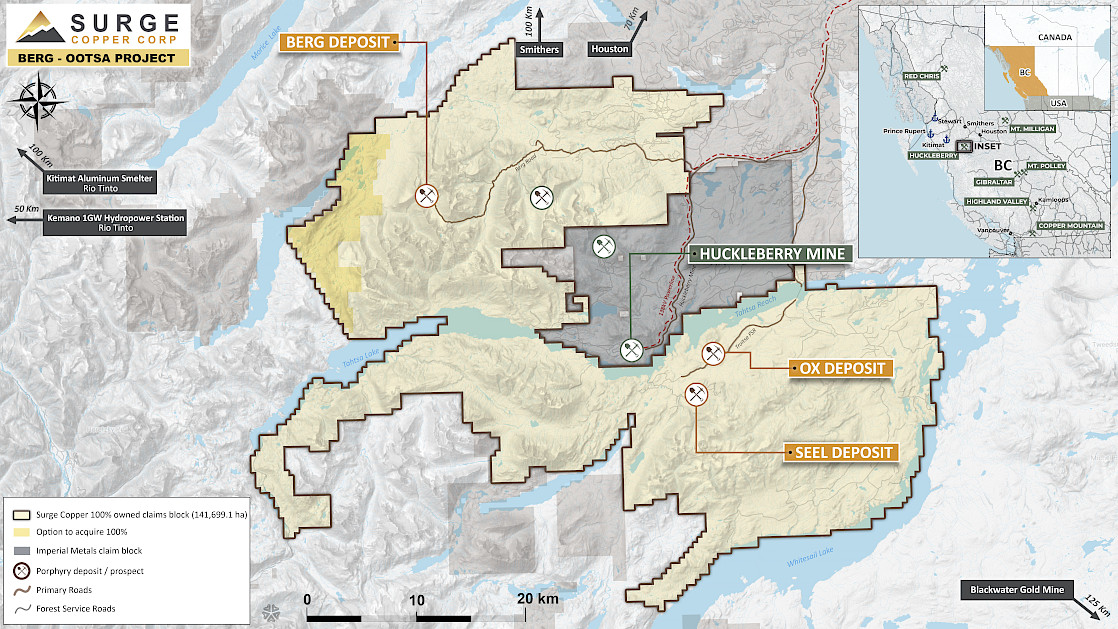
The Berg Copper Project is Surge Copper's 100%-owned flagship copper-molybdenum-silver project located in central British Columbia, within the Wet'suwet'en Yintah. The Project has advanced to the pre-feasibility study stage, with the June 2026 PFS defining a large-scale, stand-alone open pit mine and concentrator development supported by access to existing regional road infrastructure and planned connection to British Columbia's low-carbon hydroelectric power grid.
The PFS confirms Berg as one of Canada's most significant emerging critical minerals development projects, combining long-life copper production with industry leading molybdenum and silver by-product output, strong infrastructure advantages, and a defined pathway toward environmental assessment, permitting, and future feasibility-level studies.
PFS Highlights
- After-tax NPV8% of C$4.6 billion
- After-tax IRR of 24%
- Payback period of 2.9 years
- 28-year mine life
- Initial capital cost of C$4.7 billion
- Sustaining capital of C$1.7 billion
- Life-of-mine production of 8.6 billion pounds of copper equivalent (consisting of 4.9 billion pounds of copper, 602 million pounds of molybdenum, 89 million ounces of silver, and 439 thousand ounces of gold)
- Life-of-mine average annual production of 308 million pounds of copper equivalent, including 176 million pounds of copper, 21 million pounds of molybdenum, and 3 million ounces of silver
- First five years of steady-state production averaging 416 million pounds of copper equivalent annually, including 270 million pounds of copper, 21 million pounds of molybdenum, and 4 million ounces of silver
- Life-of-mine C1 co-product cash cost of US$1.95/lb payable copper equivalent
- Life-of-mine by-product cash cost of US$(0.17)/lb payable copper
- Maiden Proven and Probable Mineral Reserve of 1.2 billion tonnes grading 0.22% copper, 0.026% molybdenum, 4.1 g/t silver, and 0.02 g/t gold
- Updated Measured and Indicated Mineral Resource of 1.4 billion tonnes grading 0.21% copper, 0.025% molybdenum, 4.0 g/t silver, and 0.02 g/t gold
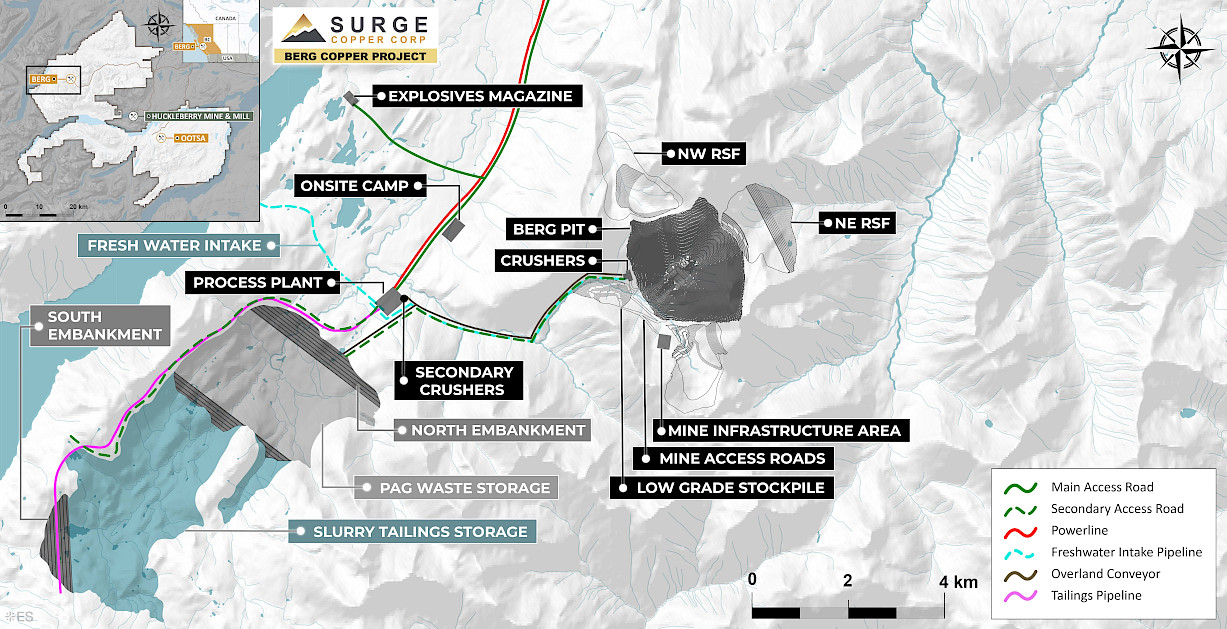
- Selected development case based on a 120,000 tonne per day concentrator, conventional open pit mining and processing, a new 230 kV transmission line, and downhill overland conveyor transport of ore to the process plant
PROJECT OVERVIEW
The PFS outlines a conventional open pit mining operation feeding a concentrator designed for a nominal throughput rate of 120,000 tonnes per day at average ore hardness. The selected development case reflects the results of engineering trade-off work completed following the 2023 Preliminary Economic Assessment and establishes the basis for a single-phase, stand-alone development of the Berg copper-molybdenum-silver deposit.
The Project is expected to be powered by hydroelectricity from the BC Hydro grid through a new 230 kV transmission line, planned to follow the same general corridor as the proposed mine access road. Access to the Project is expected to utilize existing forest service roads linking the Project to Houston, with the grid connection planned through a new connection at the Telkwa substation.
The site layout incorporates downhill overland conveyor transport of ore to the process plant, supporting efficient materials handling and reduced overall energy intensity. Together, these features support Berg's positioning as a large-scale, long-life critical minerals project with strong regional infrastructure advantages.
MINERAL RESERVE AND MINERAL RESOURCE ESTIMATE
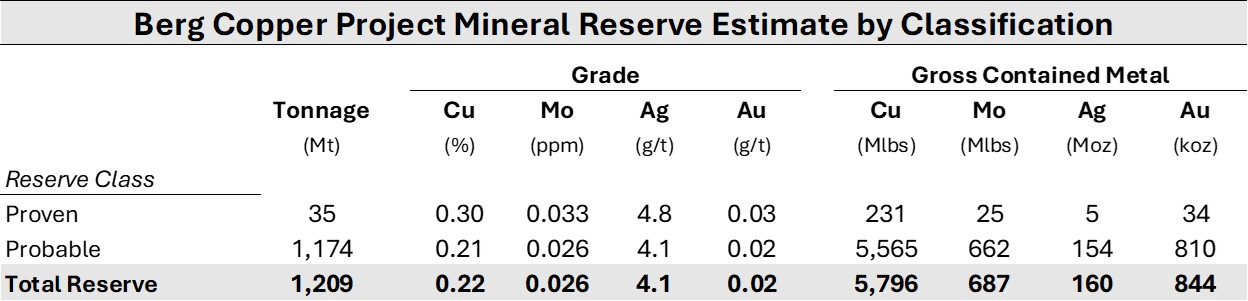
The PFS includes the first Mineral Reserve declared for the Berg Copper Project, establishing a mine plan based on Proven and Probably Mineral Reserves of 1.2 billion tonnes grading 0.22% copper, 0.026% molybdenum, 4.1 g/t silver, and 0.02 g/t gold. The reserve contains 5.8 billion pounds of copper, 687 million pounds of molybdenum, 160 million ounces of silver, and 0.8 million ounces of gold.
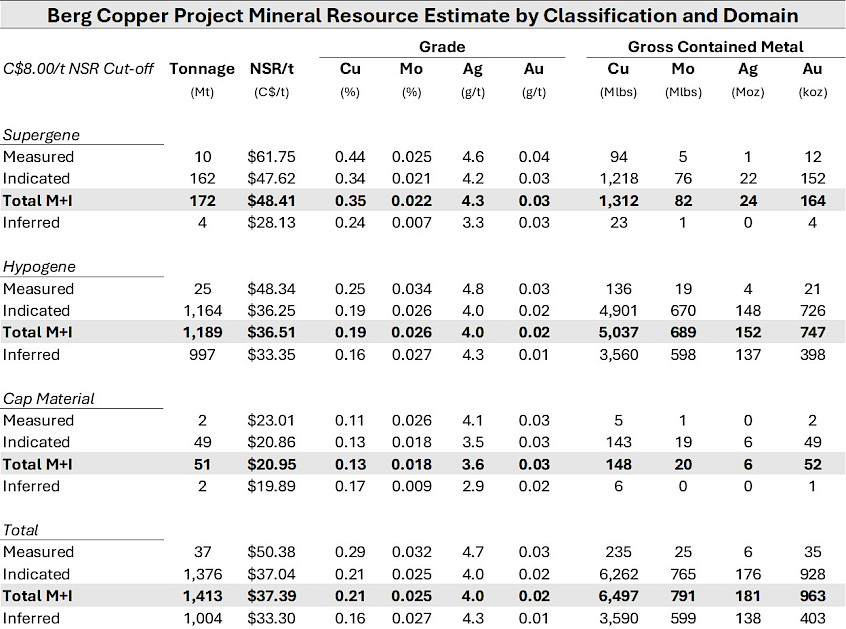
The updated Mineral Resource Estimate includes Measured and Indicated Mineral Resources of 1.4 billion tonnes grading 0.21% copper, 0.025% molybdenum, 4.0 g/t silver, and 0.02 g/t gold, plus additional Inferred Mineral Resources of 1.0 billion tonnes grading 0.16% copper, 0.027% molybdenum, 4.3 g/t silver, and 0.01 g/t gold.
The Berg deposit is a calc-alkaline copper-molybdenum porphyry system. Mineralization forms a broad annulus around the Berg Stock and includes hypogene mineralization with a superimposed supergene enrichment blanket. The scale of the mineralized system, together with the updated reserve and resource base, supports the long-life production profile outlined in the PFS.
Notes to the Mineral Reserve:
- The Mineral Reserve estimate has been prepared by an independent Qualified Person, Marc Schulte, P.Eng., of Moose Mountain Technical Services, with an effective date of June 12, 2026.
- The Mineral Reserves are a subset of the Mineral Resource Estimate, which also has an effective date of June 12, 2026.
- The Mineral Reserves are based on engineering and technical information developed at a Pre-Feasibility level for the Berg deposit.
- Mineral Reserves are mined tonnes and grade, with a reference point of ROM mill feed at the crusher. This ROM mill feed includes estimates of mining dilution and recovery.
- Mineral Reserves are reported at an NSR cut-off grade of C$9.25/t. NSR grade is based on US$4.50/lb Cu, US$20/lb Mo, US$40/oz Ag, US$3,000/oz Au, 1.35 C$:US$ exchange rate, US$50/t concentrate smelter consts, US$0.05/lb Cu refining costs, US$1.25/lb Mo refining costs, 96.3% payable Cu, 1% refining deduction and 99% payable Mo, 90% payable Ag, 90% payable Au, $230/t offsite costs, and 1.0% royalty. NSR value also considers grade and lithology dependent metallurgical recovery formulas for all metals.
- Columns may not sum exactly due to rounding.
Notes to the Mineral Resource Estimate:
- The Mineral Resource Estimate has been prepared by an independent Qualified Person, Sue Bird, P.Eng., of Moose Mountain Technical Services, with an effective date of June 12, 2026.
- Resources are reported using the 2014 CIM Definition Standards and were esimated in accordance with the CIM 2019 Best Practices Guidelines.
- The Mineral Resource has been confined by a “reasonable prospects of eventual economic extraction” pit using the following assumptions:
- Cu price of US$4.50/lb, Mo price of US$20.00/lb, Au price of US$3,000/oz, Ag price of US$40/oz at an exchange rate of 1.35 C$ per US$;
- 96.3% payable for Cu, 90.0% payable for Ag and Au, 99.0% payable for Mo, 1% unit deduction for Mo.
- Concentrate smelting of US$50/dmt, US$0.05/lb Cu refining, US$1.25/lb Mo refining, transport and offsite costs of US$100/wmt and US$130/wmt for Cu and Mo concentrates respectively, a 1.0% NSR royalty.
- Average recoveries in the hypogene of: 86% for Cu, 89% for Mo, 56% for Ag, and 52% for Au. In the supergene of: 82% for Cu, 79% for Mo, 65% for Ag, and 52% for Au. In the Cap Material: 60% for Cu, 67% for Mo, 67% for Ag, and 52% for Au.
- Net smelter prices of C$5.47/lb Cu, C$24.19/lb Mo, C$1.48/g Ag, and C$110.89/g Au.
- NSR within the Cap Material: 72.41*Cu% + 0.0357*Moppm + 0.99*Aggpt + 0.0577*Auppb.
- NSR within the Supergene material: 98.97%*Cu% + 0.421*Moppm + 0.96*Aggpt + 0.0577*Auppb.
- NSR within the Hypogene material: 103.79*Cu% + 0.0475*Moppm + 0.83*Aggpt + 0.0577*Auppb.
- CuEq = NSR/72.41 in cap material, CuEq = NSR/98.97 in Supergene, and CuEq=NSR/103.79 in Hypogene.
- Mining costs of C$2.50/tonne mineralized material and waste.
- Processing costs of C$7.00/t and G&AC$1.00/t.
- Pit slopes vary with rock type and slope azimuth.
- Numbers may not sum due to rounding.
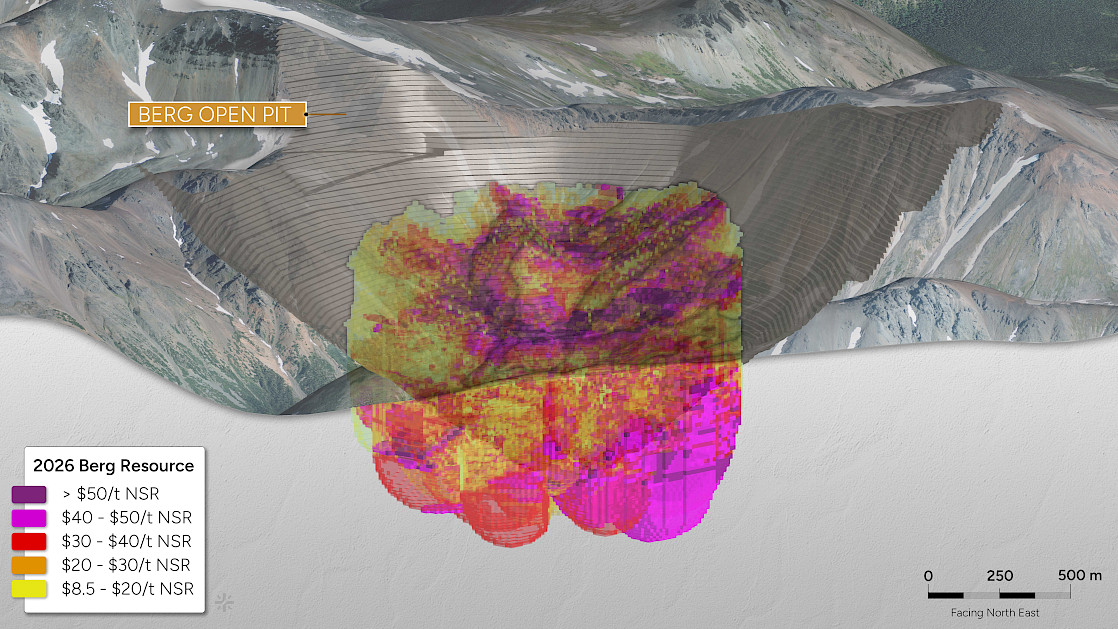
Figure. 3D View of Block Model with Reserve Pit
PFS MINE PLAN AND PRODUCTION PROFILE
The PFS mine plan contemplates a 28-year operating life based on total milled material of approximately 1.2 billion tonnes. The life-of-mine strip ratio is estimated at 2.0:1, including pre-stripping requirements.
Life-of-mine recoverable production is estimated at 4.9 billion pounds of copper, 602 million pounds of molybdenum, 89 million ounces of silver, and 439 thousand ounces of gold, representing total production of 8.6 billion pounds of copper equivalent.
The production profile is front-end weighted, with the first five years of steady-state production averaging 416 million pounds of copper equivalent annually. Over the life of mine, Berg is expected to produce an average of 308 million pounds of copper equivalent per year, including 176 million pounds of copper, 21 million pounds of molybdenum, and 3 million ounces of silver.
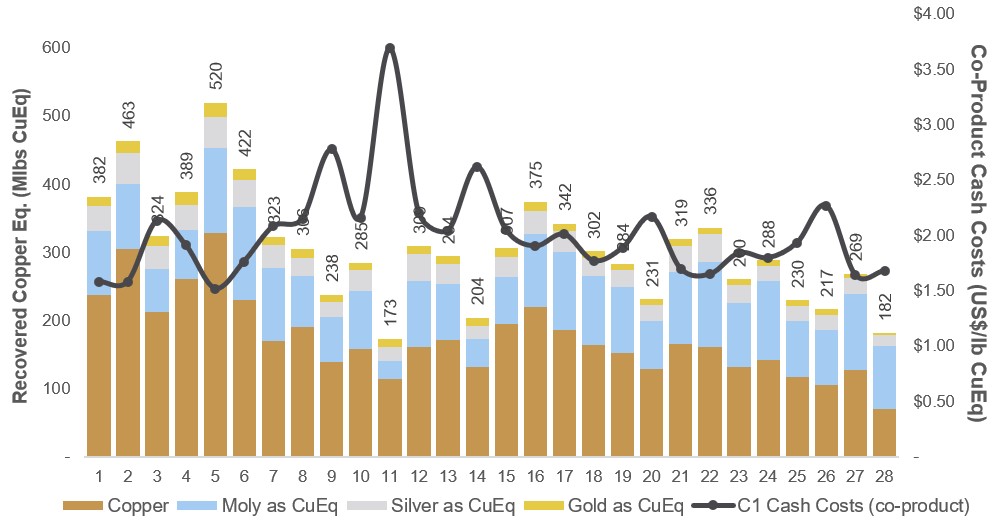
Figure. Production and Co-Product C1 Cash Cost Profile.
METALLURGY AND PROCESSING
The PFS process flowsheet is based on conventional flotation, including primary grinding, rougher and cleaner flotation stages, and copper-molybdenum separation. Metallurgical testwork completed in support of the PFS confirmed the suitability of this conventional flowsheet, with minimal regrind requirements and no dependence on specialty reagents.
The PFS applies grade-recovery regression formulas derived from the metallurgical testwork database. Estimated life-of-mine average recoveries are 84% for copper, 88% for molybdenum, 55% for silver, and 52% for gold.
The Project is expected to produce separate marketable copper and molybdenum concentrates. Independent concentrate marketing consultants reviewed expected concentrate specifications and provided input on assumed payability and commercial terms used in the PFS.
ECONOMIC SUMMARY
The PFS base case generates an after-tax NPV8% of C$4.6 billion, an after-tax IRR of 24%, and a payback period of 2.9 years using long-term commodity price assumptions of US$4.75/lb copper, US$20.00/lb molybdenum, US$45/oz silver, and US$3,500/oz gold, with an exchange rate of 0.73 US$/C$.
Initial capital is estimated at C$4.7 billion, including contingency, and is assumed to be incurred over a three-year construction period. Sustaining capital over the life of mine is estimated at C$1.7 billion. The PFS estimates total life-of-mine free cash flow of C$16.9 billion and total undiscounted net taxes paid of C$8.3 billion.
The Project demonstrates significant leverage to metal prices. At spot prices as of June 2026, the PFS spot price sensitivity case generated an after-tax NPV8% of C$9.4 billion, an IRR of 36%, and a payback period of 1.8 years.
INFRASTRUCTURE & POWER
Berg benefits from its location in central British Columbia, with planned access using existing forest service roads connecting the Project area to Houston. The PFS development case includes a new 230 kV transmission line connecting the Project to the BC Hydro grid through a planned connection at the Telkwa substation.
Access to low-carbon hydroelectric power is a key differentiating feature of the Project. In addition, the use of electrically powered overland conveyor systems for ore transport is expected to support efficient materials handling and reduce the Project's overall carbon intensity relative to more diesel-intensive material movement alternatives.
TAILINGS, WASTE, AND WATER MANAGEMENT
The PFS includes a tailings and waste management facility designed to support the long-term operation of the Project. During operations, water from the facility is planned to be recycled back to the process plant for use in flotation, reducing overall water demand and minimizing discharge requirements.
Closure and reclamation planning has been developed with the objective of supporting long-term physical and geochemical stability following completion of mining. Closure activities are expected to include removal of major process facilities, remediation of disturbed areas, re-contouring of the open pit and waste rock storage areas as required, water treatment and monitoring where necessary, and capping and revegetation of the tailings facility.
Surge intends to work with First Nations to help guide reclamation planningh in a manner that reflects Indigenous perspectives, future land use considerations, and the preferred long-term vision for the site following closure.
FIRST NATIONS AND PROJECT ADVANCEMENT
The Berg Copper Project is located within the Wet'suwet'en Yintah. Surge is actively engaging with the Wet'suwet'en Hereditary Chiefs and Houses and other potentially impacted communities in the region, including the Witset First Nation, Wet'suwet'en First Nation, Nee Tahi Buhn Indian Band, Skin Tyee First Nation, and Cheslatta Carrier Nation.
Surge believes that responsible advancement of the Project depends on working respectfully and collaboratively with First Nations whose rights and interests are connected to the Project area. The Company's approach to engagement is grounded in transparency, relationship-building, and the pursuit of free, prior, and informed consent.
As the Project advances, this work is increasingly focused on deepening relationships, understanding Nation-specific priorities and areas of concern, and ensuring that appropriate capacity and resourcing are in place to support meaningful participation in Project planning.
The Company is also planning for an Indigenous-led assessment to be carried out by the Office of the Wet'suwet'en, in parallel with and to help inform the broader environmental assessment process.
ENVIRONMENTAL ASSESSMENT & PERMITTING
Completion of the PFS provides a stronger technical foundation for the next stage of Project advancement. Surge intends to advance Berg into environmental assessment, including the planned filing of an Initial Project Description to commence the British Columbia environmental assessment and federal impact assessment processes.
The Company expects the Project will require both provincial and federal assessments and intends to seek a substitution process led by the Province on behalf of both jurisdictions. In parallel, Surge is planning for a Wet'suwet'en Assessment to be carried out by the Office of the Wet'suwet'en.
Over the past several years, Surge has invested significantly in environmental baseline programs across the key areas of the Project footprint to support future assessment and permitting activities. Together with the higher level of engineering definition reflected in the PFS, these baseline programs form an important part of the technical foundation for the next stage of Project advancement.
The Berg Copper Project has also been accepted into British Columbia's Critical Minerals Office, which is intended to support coordination and early preparedness for priority critical minerals projects as they advance through regulatory processes.
FUTURE OPPORTUNITIES
The PFS outlines a defined development case for Berg based on currently available technical, economic, and engineering information. The Project also retains longer-term opportunities that are not required to support the PFS case.
These include potential future exploration upside within and adjacent to the Berg deposit, broader district-scale opportunities across Surge's mineral tenure position, and additional Inferred Mineral Resoures located within or below the reserve pit shell that are not included in the current Mineral Reserve estimate or mine plan.
Future work is expected to focus on continued First Nations engagement, advancement into environmental assessment, ongoing environmental and cultural studies, additional technical work to support feasibility-level studies, and continued evaluaiton of opportunities to further optimize the Project.
TECHNICAL DISCLOSURE
The Berg PFS was prepared in accordance with National Instrument 43-101 -- Standards of Disclosure for Mineral Projects. Mineral Resources are not Mineral Reserves and do not have demonstrated economic viability. Readers should refer to the Company's technical report and related disclosure for full assumptions, qualifications, and cautionary language.
Dr. Shane Ebert P.Geo., is the Qualified Person for the Berg Copper Project and the Ootsa Project as defined by National Instrument 43-101 and has approved the technical disclosure contained on this website.